Exercices d’écoute en anglais · A2 · Bon débutant
Visiting Pastéis de Belém in Lisbon
Dans ce clip, tu apprends 10 mots, dont Behind (derrière), referred to as (appelés) et tart (tarte).
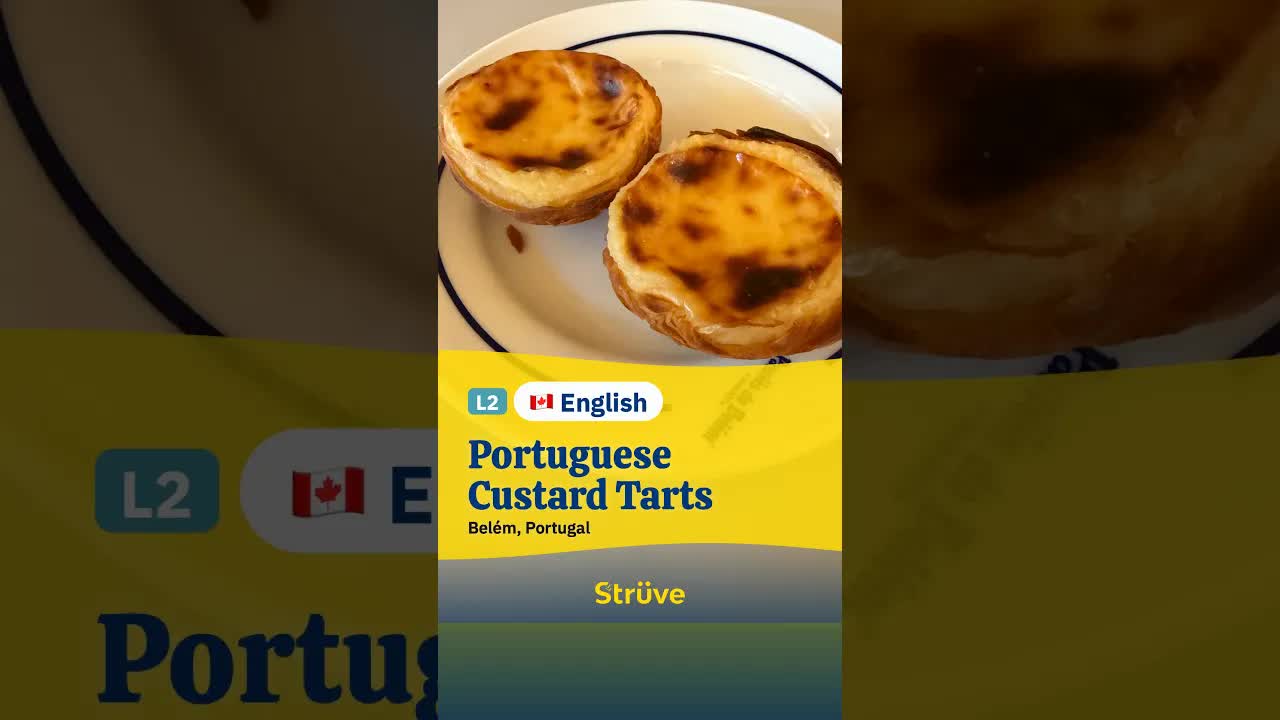


De Strüve | English sur YouTube. Voir l’original
Les mots que tu apprends dans ce clip
Chaque mot avec son sens dans ce clip et la phrase où il est dit.
- ▶ 0:02Parmi les 1 000 mots les plus courantsBehindderrière
“Behind me”
Vérifié par Robert, locuteur natifCherché par Маржона et un autre apprenant Reelang - ▶ 0:14Expressionreferred to asappelés
“created the Portuguese custard tart, which today are referred to as Pastéis de Belém.”
- ▶ 0:14Un mot plus rare, hors des 5 000 plus courantstarttarte
“created the Portuguese custard tart, which today are referred to as Pastéis de Belém.”
- ▶ 0:14Un mot plus rare, hors des 5 000 plus courantsBelémnom de lieu
“created the Portuguese custard tart, which today are referred to as Pastéis de Belém.”
- ▶ 0:14Un mot plus rare, hors des 5 000 plus courantscustardcrème pâtissière
“created the Portuguese custard tart, which today are referred to as Pastéis de Belém.”
Cherché par Fraise et Айгерім - ▶ 0:14Un mot plus rare, hors des 5 000 plus courantsPastéisnom portugais
“created the Portuguese custard tart, which today are referred to as Pastéis de Belém.”
- ▶ 0:36Expressionkind ofune sorte de
“Here they are, and we can see that they have kind of a crust around the outside.”
- ▶ 0:36Un mot plus rare, hors des 5 000 plus courantscrustcroûte
“Here they are, and we can see that they have kind of a crust around the outside.”
Cherché par Cem - ▶ 0:49Un mot plus rare, hors des 5 000 plus courantscinnamoncannelle
“It is a custard tart, and traditionally we add cinnamon, like this.”
Cherché par Fraise - ▶ 0:49Un mot plus rare, hors des 5 000 plus courantstraditionallytraditionnellement
“It is a custard tart, and traditionally we add cinnamon, like this.”
Cherché par Cem


Les mots de ce clip sont-ils courants ?
81,2%
des mots figurent parmi les 2 000 mots anglais les plus courants
Notre rechercheCombien de mots faut-il pour comprendre des vidéos natives ?
Plus de clips comme celui-ci
 Top créateur
Visiting Rue du Taur in Toulouse

Downtown Montreal One Bedroom Apartment Tour
 Top créateur
Visiting the Historic Basilica of Saint-Sernin in Toulouse
 Top créateur
The Statue in the Darkness Story
 Top créateur
Solar Energy in Portugal: A2-B1 English Lesson
 Top créateur