How do I prepare for the IELTS listening test?
The IELTS listening test plays each recording only once, and the voices use several English accents. Most people aim for about band 6 to 7.
The best free way to get ready is to listen to a lot of real English at your level. The free pack below is grouped from easier to harder, so you can start where you are and work up.
Curated and reviewed by an expert
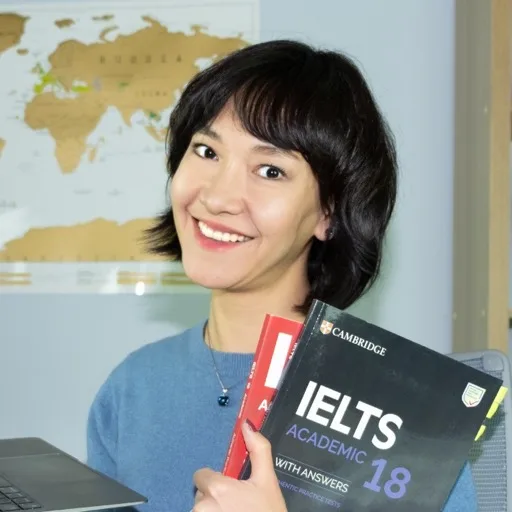
Founder of FasTrack IELTS · 2M+ YouTube subscribers
This page was curated and reviewed by Asiya, the founder of FasTrack IELTS. Originally from Kazakhstan, she sat IELTS herself to study in the UK, and now leads a global team of IELTS experts and former examiners whose structured, practical prep helps test-takers reach band 7 or higher without months of trial and error. She hand-picked the video pack below.
From an IELTS coach
How should I practice IELTS listening with short videos?
Most IELTS listening advice is the same. Do old Cambridge tests, listen to podcasts, watch films in English. It is useful, but it is hard to keep up. A full test takes a long time. Podcasts can be long and too hard. Many people start, then stop after a few days.
Short videos are easier to stay with. You probably already watch TikToks, Reels, or YouTube Shorts every day. The only question is whether you are just scrolling, or training your ear.
Short clips let you hear real English in small pieces. That is good practice for IELTS, because the test rarely uses the exact words from the question. You have to catch the meaning.
With short clips you can listen for the things you often need in the test:
the main idea
the speaker's opinion
reasons and examples
contrast, where the speaker sets up one idea then turns it around
small corrections in real speech, like "actually" or "sorry, I mean"
the same idea said in different words
fast speech and linked sounds
Here is what some of those sound like, in clips I picked for you below:
Opinion
“One of my favorite things is just walking the aisles and seeing all the options.”
The answer is her attitude, not one key word. You have to hear that she likes it.
Watch: Why We Love Malaysian Grocery Stores
Contrast
“Everything is so expensive here, but this $5 chorizo cone was amazing value.”
She sets up a price you expect, then turns it around. The real point is the second half.
Watch: Everything I Ate At The Sydney Easter Show
Same idea, different words
“She was the longest resident at the shelter, so she had been there for eight years and nine months.”
A question would ask "how long?" The audio says "longest resident," then the number. Same fact, two wordings.
Watch: Adopting The Longest-Resident Senior Dog From A Shelter
A small correction
“When I was 20, when I... a bit older than that, when I'd left university...”
Real speakers fix themselves as they go. Follow the corrected version, not the first thing they said.
Watch: Quentin Blake On Becoming An Illustrator
Use each video in a few passes:
Watch once with no subtitles. What is the main idea?
Watch again. What does the speaker think about it?
Watch again, and listen for reasons, examples, and any correction.
Check the new words or phrases.
Say one useful sentence out loud.
It is better to study one short video well than to watch twenty once. Pick videos you can almost follow. Too easy and you learn little. Too hard and you just guess. The videos below are grouped by band, level, and speed, so start near your level and work up.
Short videos do not replace full IELTS tests. You still need real practice tests for the things only the exam teaches: reading the questions before each part, spelling your answers correctly, and keeping to the word limit. But these clips are a simple way to train your listening every day. I picked each one myself to give you real English at the right level and speed.
Why this level
Why do people take IELTS?
People commonly take IELTS for:
University admission (many programs accept band 5.5; the most competitive ask for far more)
Work or migration visas for a few English-speaking countries, where the bar varies a lot
Professional registration, for example for nurses and doctors
What band do I need?
Real band requirements
How high you need to go depends entirely on why you're sitting IELTS, and unlike certificates people frame on the wall, an IELTS score expires after two years, so people take it for a concrete goal. Most university programs accept around band 5.5 to 6.5, but the real range is wide:
Skilled migration (Australia)
Competent / Proficient / Superior English
Requirements change often and vary by program and visa stream. Always confirm the exact number on the official page before you rely on it.
Free · 100 videos · 6 hours 48 minutes
Your free IELTS listening pack
Here are 100 short videos by real native speakers, grouped from easier to harder, so you can start at your level and work up. They are spoken at a speed close to the test (around 190 words a minute). The voices use several English accents, just like the test. Most of the words are inside the 96% most common spoken English words, so they match the kind of language the test uses. Together they are about 6 hours 48 minutes of listening practice for the IELTS. They are all free to watch below.
Play the whole pack in the appWhat is in the pack · 100 videos in 3 bands
Build your base
35 videos
Most university targets
34 videos
Stretch for top scores
31 videos
All 100 videos are below, grouped by band from Band 5-6 to Band 7+, so you can start at your level and work up.
Build your base

Everything I Ate At Queen Victoria Market Melbourne

Korean Street Food Tour At Gwangjang Market
Why Some People Feel The Cold More

Making Squeaky-Fresh Cheese Curds At Clock Shadow Creamery
Grizzly bears hunting salmon at the waterfall

King And Queen Experience Irish Culture In Belfast

Living Full-Time In A New Zealand Bus Home

Asking Strangers In York What They’re Doing Today

How To Become A Formula 1 Mechanic

Exploring a classic car junkyard taken over by nature

Rescued Dog Gets His First Toy Shopping Spree

Why We Love Malaysian Grocery Stores

Dads Learn Daughters’ Hairstyles Over Pints At The Pub

Rescuing A Deer Trapped In A Roadside Fence
Overcoming Fear Of Mistakes When Speaking English
Weight Loss Drugs Explained In Six Minutes

Korean beef brisket feast in Seoul

Everything I Ate At The Sydney Easter Show

American Idol homecoming for Pensacola singer Keyla Richardson

Last-Minute Mother’s Day Tech Gift Ideas

Adopting The Longest-Resident Senior Dog From A Shelter

Young Aussie climber reaches the summit of Mount Everest

Why We Built A Tiny House In New Zealand

Asian Festival Chaos: Overpriced, Overcrowded, And Frustrating

Quentin Blake On Becoming An Illustrator

How Van Life Helped Me Find My True Self

King and Queen Celebrate Irish Culture in Northern Ireland

How Journalists Find And Gather News Today

Working From Home Trends Across Australia

Cycling a sewing machine to stitch street portraits

Tiny home problems fixed after news investigation

Teen Aussie Becomes Youngest To Conquer Mount Everest

Police Officer Catches Baby Thrown From Burning House

Make Your Cat Happier With Play And Puzzle Feeders

COVID-19 Vaccine Hashtags And Social Media Reactions
Most university targets

Living Inside A Real English Castle

Exploring Derry Girls murals and the city’s history

Deer Rescued From Spiked Fence Just In Time
Why Deep Squats Matter For Your Long-Term Health

How A Wild Robin Changed This Man’s Life

Why We Left The US For Life In Spain

Oklahoma Mentoring Program Urgently Needs More Volunteers

Longwood Debates Building New Tiny Home Communities

The Changing Role Of Pubs In British Society

Fuel Crisis Threatens Australian Food Supply

Modular Homes And Australia’s Tradie Shortage Explained

World Cup referee denied US entry and dropped

Little Havana Reacts To Raul Castro Indictment

Overcoming Fear And Giving Better Presentations With RADA

Memphis police warn drivers after deadly pedestrian crashes

Housing, smart glasses and choosing pets over kids

How Small Joys Build Real Happiness Over Time

Allowing Emotions To Flow Through You

How To Handle Painful Emotions Like A Psychologist

Easter Food Traditions In Italy And Slovenia

Trump And Xi Discuss Trade, Iran, And Relations

Exploring An Ancient Egyptian Sun Temple To Ra

San Damiano Park Renovations And Community Fundraiser

Why Denver’s Nighttime Stoplights Are Changing

Preparing For The Next Pandemic After COVID-19

How Pop Culture Is Redefining Modern Motherhood

Filmmaker Plans Bionic Eye To Film Surveillance Society
How Deeper Conversations Can Make You Happier
New Marine Species And The Vast Unknown Ocean

Taking Risks, Embarrassment, And The Power Of Stories

Three Signs You’re Gaslighting Yourself

Understanding Highly Sensitive People And Their Strengths

Why Airplane Turbulence Is Getting Worse

How Trump–China Tensions Affect Apple And The Bay Area
Stretch for top scores

Jury Dismisses Elon Musk Lawsuit Against OpenAI

Why Daylight Saving Time Still Exists

Talking About Roman History And Modern Society

Legal battle delays Victoria corruption report release

What Spirit Airlines’ Collapse Means For Cheap Flights

Astronaut Explains The Stories Behind Iconic Space Photos

Why Birth Rates Are Falling And What It Means

Why Plankton And Bioluminescence Matter For Our Oceans

Why Dragonflies Are Such Incredible Flyers
The Six Eras Of NBA Fashion And Power

Gunshots Near White House And Tense US–Iran Talks

Minnesota Sues Nonprofit Leaders Over Misused Millions

ICE Detention Stalls Louisville Carjacking Case

Why Alex Murdaugh’s Murder Conviction Was Overturned

Royal Commission Probes Bondi Counterterrorism Funding Decisions

CTU-Backed Candidate Runs For Chicago School Board President

Chicago Summer Safety, Youth Programs, And Bears Stadium Politics

Experts Answer Big Questions About AI And The Future
Why Australia’s Major Parties Are Losing Voters
The Problem With Billionaires And True Net Worth

Doctors Discuss Hantavirus, Ebola And Mental Health

Mary Beard On Rome, Celebrity Culture And Ordinary Lives

Connecting Roman history to modern politics and rights
How Survival Became My Cage And How I Escaped

US–Iran Standoff And The Strait Of Hormuz Blockade

Australian Budget Fallout And Calls For Early Election

Marianne Williamson on environmental justice and reparations

U.S.–China Trade, Taiwan Tensions And Iran Nuclear Concerns

US Midterms, Economy And Party Poll Numbers Explained

Iran Regime, Blockades And Verification After U.S. Strikes
Brooks And Capehart On U.S.–Iran Deal And Trump
The test
What does the IELTS listening test look like?
The listening test has four parts, with 40 questions in total, and takes about 30 minutes. On the paper test you get 10 more minutes to copy your answers. Here is what you hear in each part:
Part 1
An everyday conversation between two people, for example booking something or asking for information.
Once
Part 2
A talk by one person about an everyday topic, like local places or an event.
Once
Part 3
A conversation about study or training, with up to four people.
Once
Part 4
A talk on an academic subject, like a short university lecture.
Once
Each recording plays once only. There is no replay, so you need to follow real speech the first time you hear it.
The voices use several English accents: British, Australian, New Zealand and North American. The parts get harder, from everyday talk up to an academic lecture.
Level and words
What level and how many words do I need?
Listening needs far fewer words than reading. Research shows that about 3,000 common words cover roughly 95% of normal speech, and the first 1,000 words cover most of what people say.
Video is the easiest way to understand, because the pictures help you guess the meaning. So you do not need a very large vocabulary. You need the common words, some topic words for the academic parts, and a lot of listening practice at your level.
Watch videos with visual cues, on YouTube or here on Reelang.
Based on research
Nation (2006) About 3,000 common word families cover roughly 95% of everyday spoken English; reading needs far more.
Webb (2021) The most frequent 1,000 words alone cover most of what people say in speech.
Durbahn et al. (2024) Video is easier to understand at a given vocabulary size, because the pictures help you guess.
Ways to practice
Common ways people practice
There is no single right way. People use a mix of these, and the free pack above works as a companion to any of them.
A class or a teacher
English news, like the BBC or your local English news
Talks and short documentaries where people explain ideas
Watching real English videos at your level
Start watching now, no email needed
Explore English videos by accent: British, Australian, New Zealand and North American
Good to know
Frequently asked questions
How was this IELTS pack chosen?
We did the searching for you. We check thousands of English videos and measure each one: its level, how fast it is spoken in words a minute, and how many of its words are common. For this pack we kept clear videos across British, Australian, New Zealand and North American accents, at a speed close to the test (around 190 words a minute), where about 96% of the words are among the most common in spoken English. We split them into groups from easier to harder, so you can start at your level and work up. Then we read the transcripts by hand to keep the everyday and academic topics the test uses, and we put the clearest, most visual videos first. About 3,000 common words already cover roughly 95% of normal speech (Nation 2006), so this kind of content matches the test well.
What kind of videos should I practice with for IELTS listening?
Use real English spoken at a normal, real-time pace, in a mix of accents like the test uses. Pick the everyday and academic topics the test uses, like society and current affairs, history and culture, science and nature, health, food and housing. You do not need rare words. About 3,000 common words cover most of normal speech (Nation 2006), so content built from the most common spoken words matches the test well. A good mix is everyday conversations, short talks and a clear lecture, because the test moves from social topics up to an academic talk. That is exactly how the free pack of 100 videos above was put together.
Does the IELTS listening audio play once or twice?
Once only. Every recording plays a single time, so the test rewards being able to follow real speech the first time you hear it. That is why practising with real video at natural speed helps so much.
What band score do I need?
It depends entirely on your goal, and the range is wide. Many university programs accept band 5.5 to 6.5, while the most competitive ask for far more: Columbia's journalism school requires 8.0. For migration the bar swings from around band 5 for some skilled trades in Canada up to band 7 or 8 to be competitive for Australia or Canadian Express Entry. The table above lists real examples with sources. Always check the exact number with the place you are applying to, because requirements change.
Which accents are used in the IELTS listening test?
The test uses several native English accents, including British, Australian, New Zealand and North American. The free pack above spreads across these accents, so you get used to more than one.
How do you know each video's band level?
We read each clip's transcript and look at the language in it, how common the words are, whether there are idioms, phrasal verbs, passives or complex sentences, and how academic the topic is, then match that to the kind of language IELTS uses at each band. So each video is labelled with the band range its language is typical of, and the pack is grouped from easier to harder so you can start near your level and work up toward your target band.
Can I prepare for free?
Yes. A good free start is the official IELTS sample tests on ielts.org, where you can try the real listening tasks. After that, the best free thing you can do is listen to a lot of real English at your level. Start with the 100 videos above, or watch more on YouTube or here on Reelang.
Is video better than textbook audio?
For listening, yes. Textbook audio is often slow and very clear. Real video uses normal speed and real accents, which is closer to the test, and the pictures help you guess words you do not know yet.
What CEFR level is each IELTS band?
Roughly: band 4 to 5 is around B1 (intermediate), band 5.5 to 6.5 is around B2 (upper-intermediate), band 7 to 8 is around C1 (advanced), and band 8.5 to 9 is around C2 (proficient). So the band 6 to 7 most people aim for is about B2 to C1. These are approximate: IELTS is scored on its own band scale and the CEFR levels are only a guide.
Can I practice IELTS listening with short videos like Reels or YouTube Shorts?
Yes. The test rewards understanding real speech the first time you hear it, and short clips let you train that a little every day. Watch a clip once for the main idea, again for the speaker's opinion and reasons, then check the new words. Do this with full practice tests as well, so you also get used to the exam format and timing.
What level of video should I start with?
Start with one you can almost follow, not one you understand perfectly. If it is too easy you learn little, and if it is too hard you just guess. The videos above are grouped from band 5 to band 7 and up, so begin near your level and work up.